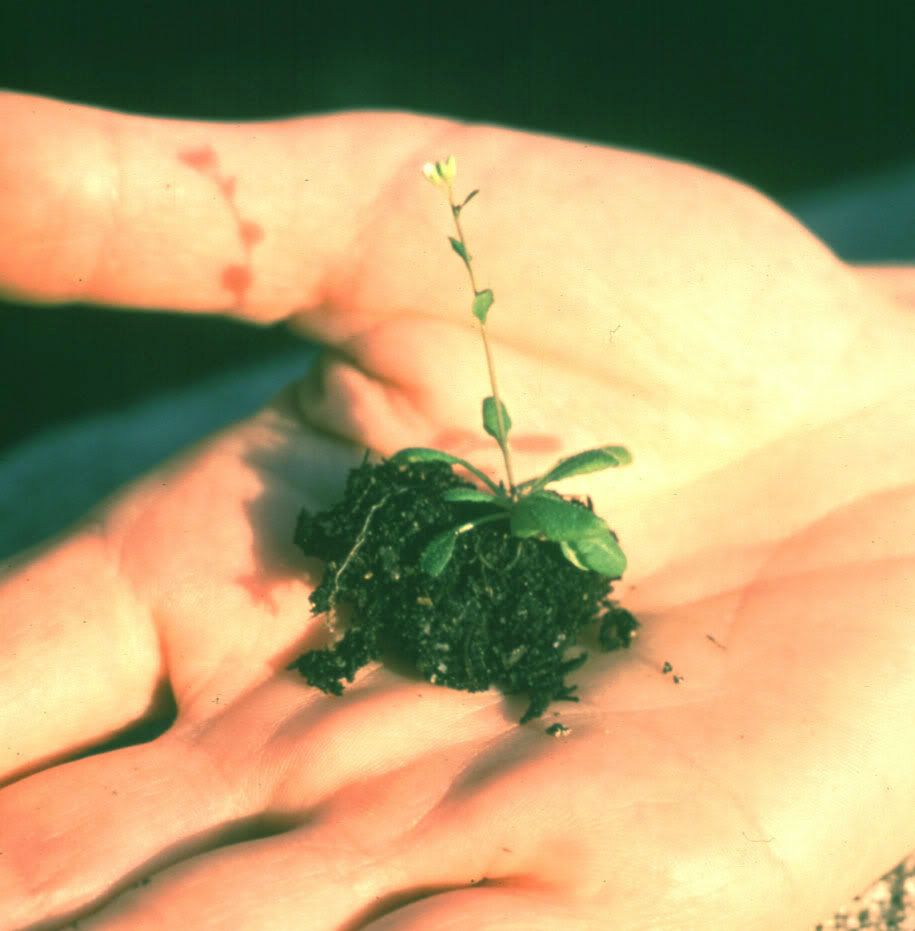
Arabidopsis thaliana has long been considered the model plant for gene study for a number of reasons. First of all, it has a remarkably low gestation period, and can grow from a seed to a mature, fertile plant in as little as a month and a half. Secondly, they are very small, (image) even when fully grown. Their size makes them very easy to store in a laboratory, where space may be limited. They produce a large number of seeds, in some cases as many as thirty thousand. They also require very little light for photosynthesis. Fluorescent bulbs are enough light to allow Arabidopsis thaliana to develop properly, allowing scientists to have near perfect control over the intensity and duration of light exposure.
In summary, Arabidopsis thaliana is a good plant to study because it matures quickly, is easy to raise and store, and produces lots of seeds. Now, on to the real juicy part of my project. Again, I will try to use as little jargon as possible, but it is unavoidable at times. Wikipedia is your friend.
Essentially what I will be doing is investigating various plant mutations, and how these mutations manifest themselves during plant development. More specifically, I will be looking at the receptor proteins of developing cells of the plant Arabidopsis thaliana, which you undoubtedly know and love by now.
Through years of study, the scientific community has become aware of receptor proteins that are present in plant cells. It has been theorized that some of these proteins may be responsible for the communication between developing cells.
It is helpful to think of the plant not as a single entity, but rather a collection of individuals (cells) that must cooperate to accomplish their tasks. For instance, when the sprout senses sunlight, how do the leaves know how to grow? When the plant is tall enough, how do the cells know to stop dividing? As I previously mentioned, receptor proteins may play a significant role in this "communication."
In order to understand the role of these receptors, we must first see what a plant behaves like without them. (This is where the fun part begins.) If we can trace the protein to the genetic level, we can essentially turn the protein on or off. If we mess with the DNA that codes for a specific receptor protein, we can produce a mutant plant that does not have said protein. By inducing mutations with various carcinogens, we can produce new mutant strains to compare to our normal control group. If mutant plants that lacks Receptor Protein X are consistiently significantly shorter than is normal, we can safely conclude that X must have something to do with plant height.
Okay, so now the last part: Why should you care? Is a missing receptor protein really something to lose sleep over? Well, first of all, I would like to say that this research is worthwhile simply because it will help sate our human curiosity that is known as Science.
That's not all! For all of you pragmatic cynics who think that research is a gratuitous expense, this research could positively affect you. If we are able to apply what we learn about Arabidopsis to other, more marketable plants, we could greatly improve agriculture. In fact, one of the observed mutations in Arabidopsis thaliana is the presence of larger than normal fruit organs. If we could do the same with our produce... well, can you say forty-pound watermelon? (If that doesn't excite you, you're simply a lost cause.)
The potential benefits in this field are staggering. In addition to science for it's own sake, mankind could in the future engineer more efficient, nutritious plants that can survive in harsh climates. These advances alone could put us on the way to solving world hunger and poverty, and help us be better caretakers of our planet.
Whew, sorry if I was a bit long-winded there. You have my gratitude if you actually read my entire post. Expect another update either tomorrow or Tuesday.

Josh, this was an excellent summary of your project. Sounds cool.
ReplyDeleteIt's great to hear you so excited and involved!
ReplyDelete